Illiquidity within Industry Funds may prove problematic

Industry funds over the years have crept up their holdings in growth assets in their balanced funds in order to have increase performance during good times, that in itself is not necessarily a bad idea. Then, they also hold an increasing portion in unlisted assets, maybe infrastructure, direct property holdings or private equity and other 'alternatives', which don't get repriced daily on stock or bond markets.  This then lessens the volatility which has helped these fund experience seemly good returns, with less volatility. But, as I say, there is never a free lunch when it comes to investing and I think I can see the waiter coming with the bill.

As an example of the differences of unlisted assets not being subjected to the same volatility, as of March 30, Blackrock’s iShares Global Infrastructure ETF (Exchange Traded Fund so it is priced daily by the market) was down 28% this year. In comparison, over at super fund Hostplus, their infrastructure option was down a mere 2.8% this year, as per their valuation on March 27. That type of small write down doesn’t pass the sniff test.
These unlisted assets are now causing some panic within the superfunds themselves. The government, making another sweeping change with the stroke of a pen, saw fit to open up superannuation to unexpected withdrawals. Self-assessed, non-taxed withdrawals from members who’d lost their job or suffered a 20% income decline. The superfunds are demanding the government help to facilitate withdrawals, so they don’t need to liquidate assets in a crunch.
Some funds, led by the union-and-employer-controlled industry sector, want the government to underwrite a “liquidity backstop facility” that would provide immediate cash to pay withdrawals. For-profit funds oppose the idea. There is no suggestion any super fund is at risk of collapse. Rather, industry sources fear that the forced sale of assets would crush their value, crimping returns for people who remain in the fund.
Again, legislative risk and liquidity risk. If anyone should expect legislative risk, it’s the superannuation industry. The decision is a poor one, but we’ve warned about superfunds and their illiquid assets in the event of the worst. The worst happened. There is regular sabre rattling from one side of politics about superannuation funds. The LNP hold a decidedly dim view of superannuation. A cynic might suspect because it was a Labor creation and now the largest superannuation funds in the country have links to their mortal enemies, the unions. Liberal Senator, Andrew Bragg making an opportunistic, but relevant point.
Superannuation funds which may have overextended into illiquid assets, such as infrastructure and property and who did not retain adequate cash and other liquid holdings, did so knowing the risks they were adopting… To tout strong investment returns off the back of illiquid assets in the good years, only to come to the government cap in hand when markets inevitably turn, is simply a sign of bad management and poor investment governance.
To name super funds, it is reported that HostPlus and Rest super are potentially in the worst liquidity position because their members (hospitality and retail) are going to be the biggest proportion of people who take up the $10,000 superannuation withdrawal. Further to this, HostPlus started to liquidate some of their holdings in ISPT which is an unlisted property fund. ISPT, may now have to liquidate some of the assets within that fund, which gets back to actually testing if those valuations are correct by actually selling the asset at the moment. If the price is lower, this will have an impact on all the superannuation funds that hold these unlisted assets as the valuations across the board will have to come down.
I remain extremely satisfied with our investment philosophy and at the moment, the complete liquidity and with all assets traded and repriced daily on markets, means that whilst we feel every bump in the road with volatile markets, it also means we aren't left holding an asset that not priced correctly and potentially weighing down future returns as those mispricing's come to fruition. 
This represents general information only. Before making any financial or investment decisions, we recommend you consult a financial planner to take into account your personal investment objectives, financial situation and individual needs.

COVID19, World War 2 and a look at markets

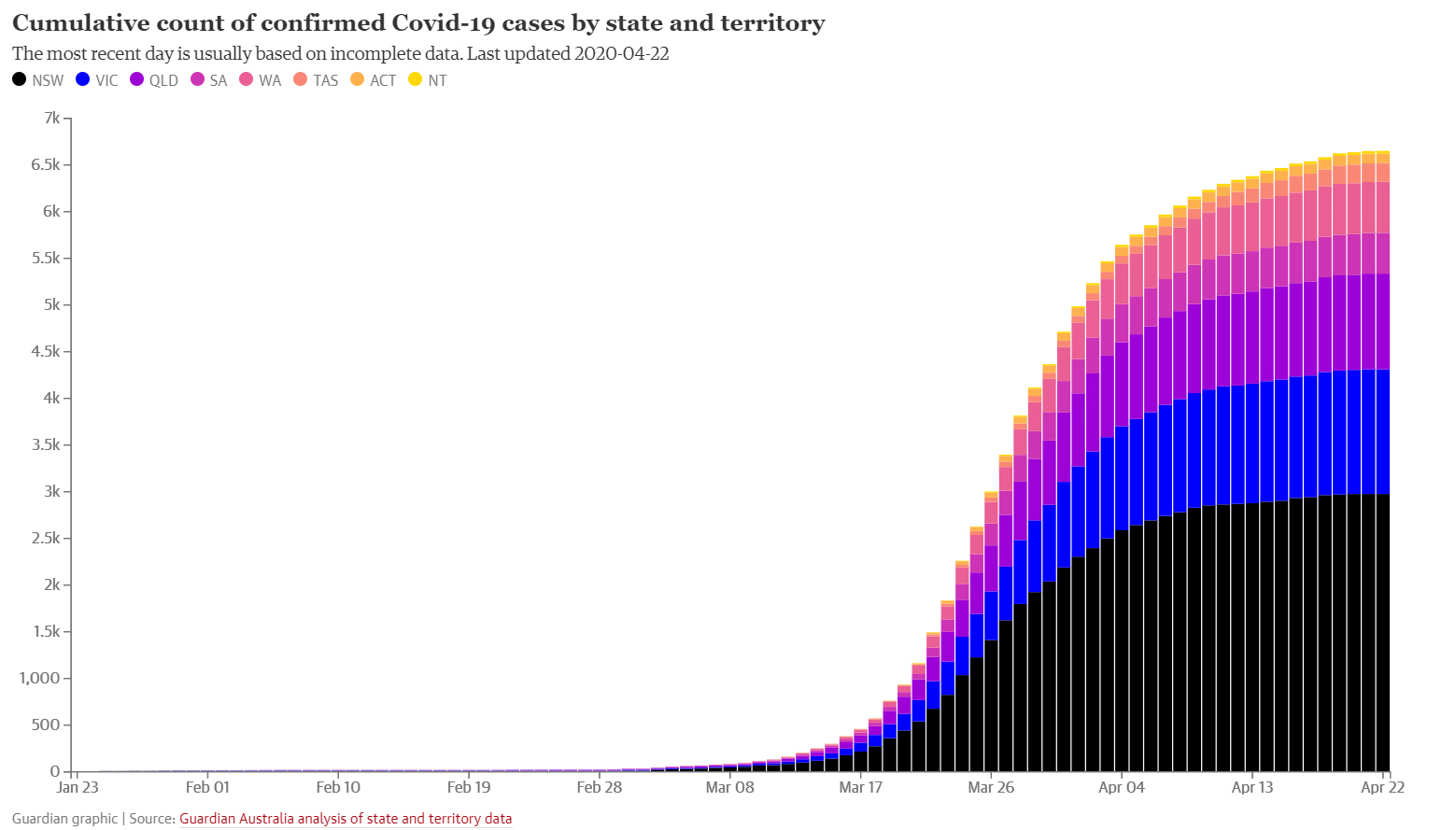
Firstly, it's been great to see the huge reductions in new daily cases across Australia and possibly some light at the end of the tunnel.
You can see in the graph below just how quickly our curve of total infections has flattened, I don't think a result better than this could have been expected just a few weeks ago.
Graph via The Guardian
This is another positive. We might be able to enjoy some freedoms again, however, will need to remain cautious coming into winter. A second wave, as seen recently in Singapore, will do us no favours.
Markets, as always, remain unpredictable. Who knew a contract on oil might go into negative territory? Without anywhere to store oil it becomes more about the price to hold it than the actual price of the commodity.
Back to shares, and for almost the last month there has been a substantial rally. Up 20% plus on the Australian market and up 30% plus in the US. Even with these upward movements there have been some large falls, especially on the ASX. Falls of 5%, 3.5% 1.6% 1.3% and 1.2%, all within a confine of a 20% rally that occurred in less than a month. That is volatility.
Markets will be more sensitive to various pieces of economic and financial data. We should expect them to swing wildly for the foreseeable future. We’d like to hope they would at least hold their ground, but they could as equally revisit previous lows. Nothing should be discounted as a possibility. Even going upwards again.
Possibly the best way to consider the impact of COVID-19, in respect to the various curtailments and their impacts, would be akin to countries when at war. Travel is effectively off limits; various parts of the economy are shuttered, and freedoms are curtailed. In respect to a war they are generally multi-year events. Gauging the prospect of a war’s end? Hard to do. We would hope COVID-19 won’t be a multi-year affair.
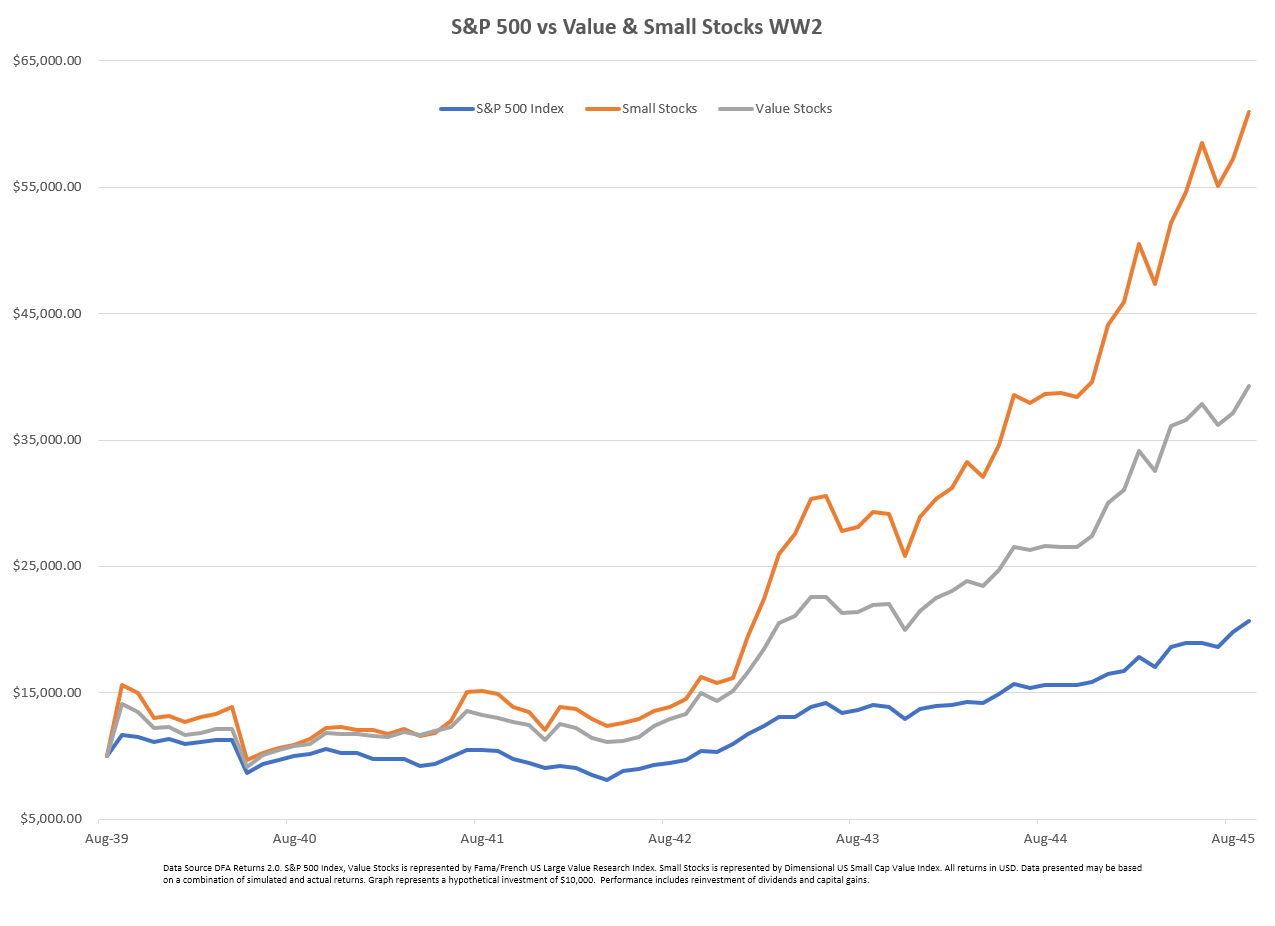
In considering market movements One particularly interesting chart is the behaviour of various market factors around WW2. Across the six-year period of WW2, the S&P 500 doubled in the US, but at one point it fell 38%. What’s interesting is the behaviour of small and value stock indexes during that period. Small stocks were up over 500% during WW2 and value stocks were up nearly 300%. At one-point small stocks fell 52% and value stocks fell 48%.
The idea is being around to capture the gains when they appear. If an investor has stuck around for the risk, they may as well enjoy the reward. It is also important to keep in mind there will be various factors in the market that may outperform when a recovery eventuates.
Finally, we’re pleased to note, we have had no reports of any COVID19 cases from us, our friends or family or businesses in our little area. Also, across our clients, we’re happy we haven’t had any reports of COVID-19 exposure. We hope this continues and you all remain in good health.
Until next time.
Reproduced with permission from Mancel Finanical Group. This represents general information only. Before making any financial or investment decisions, we recommend you consult a financial planner to take into account your personal investment objectives, financial situation and individual needs.

Common traits of successful "Mum and Dad" investors

I was having a discussion the other day about property investing versus share investing and people often think one is better than the other based on anecdotal evidence "my uncle did very well owning property - he's owns a few houses and they have gone up from $70,000 in 1994 when he bought them to about [insert large figure here] now" or "my grandfather bought lots of commonwealth bank shares when they floated and kept buying more and reinvesting the dividends and now his portfolio is [insert large figure here]"


We often get caught up in worrying about which asset class produces superior returns and overlook the common trait these people have.

In virtually every case, these people would have owned thier investments for a VERY LONG period of time. They remain disciplined throughout an ever changing world around them. It's easy to look backwards and see the start point to now and think it's easy, but not so easy when you are on that journey and there is so much noise in life, the media and the world around you.

The other trait of successful investors that I notice is they are thrifty. You might call it cheap. They probably wear older clothes, take cheaper holidays, go to every effort to minimise general expenditure like buying specials or reduced to clear items or not buying brand name groceries. Maybe thier TV is older and saller. Not buying a new car regularly and when they do buy a car, they do so with saved money. I could go on, but I think you get the picture. What it looks like exactly does vary because some people earn a lot more than others, but the comminality is that they make sure they spend less than they earn and do so regularly.

Image result for reduced to clear
I love these stickers
Sure, we want to invest in assets that are going to produce the best return over the period we are going to own them, but some things are out of our control - so focus more on the things we can control. Being disciplined and investing for the long term, spending less than you earn and invest the difference and make sure you remove risks where you can like being diversified.


Is it a good time to invest?


Is it is a good time to invest? 

This is a question I get a bit and just last week I had a client say that due to the US/China situation - they'd like to hold off as to not lose money straight away.

When you think logically about how the market works, the notion that information or news that we have now means the market will fall tomorrow, next week or next month is really quite silly.

Every day there is an equal amount of buyers and sellers. Good days or bad days - there is always someone selling and someone buying. Obviously, news about a trade war or whatever it might be that week, impacts what people will be willing to buy or sell shares, so the price moves at that instant, to a point where buyers and sellers mutually agree on a fair price based on all the information available at that time.

Image result for us trade war

Whilst looking at a single trade, you might have the assumption that one person in that trade has more knowledge or insight than the other, but collectively, there are billions of trades that take place every day. And the collective knowledge or all the people making those trades is the pricing mechanism used to find fair price for each stock.

I am 100% certain that you, me, Kochie, Tom Piotrowski (yes I had to google how to spell it) and even Warren Buffett, does not possess more information than the collective knowledge of the market so to suggest the market is not priced correctly based on the information available today, is not much more than laughable.  Warren Buffett would be the first to admit this - which is exactly why he has been such a successful investor - he's spent his efforts in investing controling the things he can control and not worried about the things he can't control.

Image result for warren buffett i never attempt to make money on the stock market

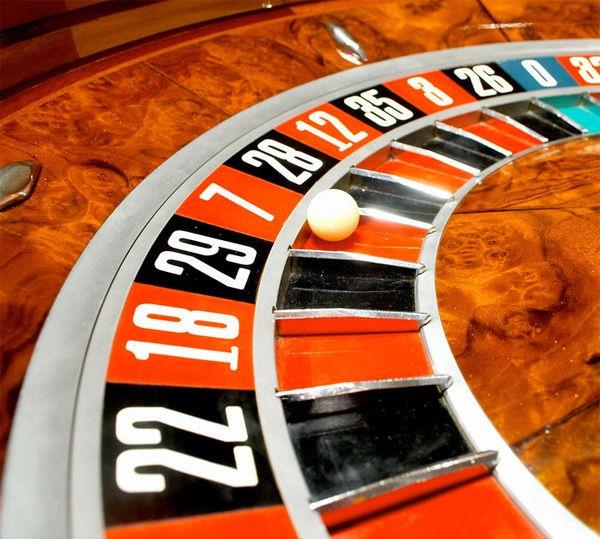
Sure, we can have a punt that things might evolve more negatively than currently expected and think the market will fall further, but, it is nothing more than a punt and when you starting guessing on where the market might move and make investment decisions based on that, you will inevitably underperform the guy who acknowledges the power in markets and pricing and simply accepts the volatility that comes with investing in equity markets. We might be right the first time, or the second time, just like if I play roulette, I might guess red or black correctly, but when I start thinking I possess the ability to correctly guess and start putting the household wealth on red or black, things can come unstuck.

Image result for roulette wheel

But - stocks can fall next week, next month and next year and some people might not be willing or in a position in life to accept that, which is exactly the reason why asset allocation of an investment portfolio is so important. 1. investing in stocks means being diversified globally to diversify away some risk and 2. having an allocation to defensive assets such as cash, fixed interest and bonds, is also so important.

It's also important to remember, that to shun growth assets such as stocks or property, you are open to other risks such as not achieving a sufficient return to meet your goals.

So, is it a good time to invest? Yes. And so is tomorrow, the day after and the day after that. Accept the power in market pricing and know that we are not smarter than the collective knowledge of all participants. And the next time the market falls 10%, 20%, 30% etc, it's still a good time to invest. The important thing is to remain disciplined and diversified.

Glenn Hilber is a Certified Financial Planner with over 10 years experience and the owner of Precision Wealth Management. Glenn can be contacted on 1300 200 012 or email enquiries@precisionwm.com.au

This represents general information only. Before making any financial or investment decisions, we recommend you consult a financial planner to take into account your personal investment objectives, financial situation and individual needs.

Insurance in Super. Is it Super?

I was reading this week the ask an expert section in the Brisbane Times and a question was put forward of a sad situation, but highlighting a significant issue with group insurance policies (typically those in industry funds, employer superannuation funds and sometimes direct employer funded policies).

The link to the article is here.

The situation is that the person originally had income protection insurance cover within their industry superannuation fund that had a benefit period until age 65, but at some point along the way, the policy was changed to a 5 year benefit period. Now she is on claim and nearing the end of the 5 years without being able to return to work, it's a problem.

She would have been notified at the time the change was made and perhaps ignored it (as many probably do). But what happens a lot is that we have medical issues along the way such as: back problems (insurers hate back problems as it is a common area of claim), perhaps you have had to take some time off work due to mental illness and have been taking some medication (again, mental illness is a big area of claim). So if your group policy is now changed so that it no longer suits, then you wouldn't be able to get new policy elsewhere, even if you wanted to. So they are just stuck with the fact their policy covering them to age 65 has just been slashed to 5 years.

The same thing happened to the definition of what is total and permanent disablement for those covered within AustralianSuper many years ago which negatively impacted millions of members (Link)

What you want in an insurance policy is guaranteed or non cancellable. This means that providing you keep paying the premium, they have to cover you for what is listed on your policy schedule and as per the terms in the product disclosure statement at the time you took out your policy.

The other thing is that when you are in a group insurance policy, you need to stay within that group. So, if that is in a superannuation fund, that means to keep getting than cover, you need to stay within that superannuation fund - so if some health issue occurs that prevents you from getting new cover elsewhere, you are handcuffed to that superannuation fund. The same is true with group policies provided by your employer, if you leave that employer, that cover is gone too.

The thing is, for most people, the premiums for a quality non cancellable, retail policy is usually just as good, or thereabouts, compared to the group policies I've been speaking about. You are still able to fund these policies from superannuation, but they aren't linked to one specific fund so you can in the future change fund or start a SMSF, and maintain your insurance policy which can be so valuable for so many people.

If you've got a retail policy and it feels like it's very expensive, it could well be, but that is probably because it's got too many bells and whistles (the group policies are always bare bones) or the sum insured is to high or you're a smoker (that really puts the premiums up).

So, to answer the question of this blog - is it Super? Well, for those group policies - No! They kind of suck.

Do you want to review your insurances? Give me a call on 1300 200 012 or email enquiries@precisionwm.com.au

Glenn Hilber is a Certified Financial Planner with over 10 years experience and the owner of Precision Wealth Management.


This represents general information only. Before making any financial or investment decisions, we recommend you consult a financial planner to take into account your personal investment objectives, financial situation and individual needs.


World Cup Predictions


Well, the world cup is on again and so is all the psychic animals that move towards a team logo/flag to predict the winners.

Image result for world cup animal predictionsI do hope that everyone realises that no animal possesses the ability to see the future results of football games or are really good sports tippers, and it's all just a little bit of fun. But, how is it that we actually got here and how does this relate to investing?

Well, if I got 100 dogs to go towards a winning team for a match, then, just like tossing a coin, you would expect roughly half of them to go towards the correct one. So, 50 have got it wrong and just go back to being good boys, but the other 50 are right, and continue on predicting for the next match. Again, about 50% of them get it right, and so on and so forth.

After 6 matches (3 group stages, round of 16, quarter finals, semi finals) you would likely end up with 1 or 2 (100 - 50 - 25 - 12 - 6 - 3 - 1) that have got it right throughout the whole world cup just through shear numbers and random chance. So, on the days leading up to the grand final, this 1 dog winds up on The Project, Sunrise, Today Show about how it can predict the games because they've done it the whole world cup (there might even be video's of it doing it before each game). To someone external, it seems pretty amazing but to the person who's been able to view the whole thing and has seen it's just been a game of numbers and random chance and there's 99 dogs just off to the side wagging their tail, still being good boys, but having failed at some point along the way, then the feat doesn't seem so impressive.

So, how does this relate to the world of investing?

Well, a couple of ways.

1. Occasionally news.com.au or some other media outlet who's desperately trying to create new content every day will bring out a news story about how we're heading for recession this year. The stock market is about to crash this year. Property prices are set to fall - or whatever it might be - some prediction - usually negative. And the basis for listening to 'expert' predicting this is because they predicted the GFC or some other major financial event. The thing is, these people are predicting things all the time AND there is a whole raft of these types of people making predictions, that, just through numbers and chance, someone will nail it. What we do wrong, is we then attribute skill or the power of foretelling the future to that person, rather than seeing it for what it is - the 1 lucky dog.

2. In the world of investing in shares - outperforming the stock market as a whole is the goal. A very low cost way to invest in shares is to purchase an index fund - be diversified across all stocks in that market, and simply achieve the market returns so no stock specific risk. But the problem with outperforming the market is markets are very efficient (meaning that prices reflect all information at hand) which makes it very very difficult to outperform the market and also because it costs more money to try outperform the market too. But, some people do outperform the market (Refer to prediction dog on sunrise) and again, we think this out performance is based on their skill rather than just luck. It is very very difficult to say without a doubt that it isn't based on skill, and that's why this idea of investing remains. On top of that our inbuilt desire to do better than the next guy, our neighbour etc means it very hard for us to accept "Just the index return" even if statistically, trying to do better will likely mean you'll do worse.

It's so much more complex than just asking every stock picker to pick a stock that will out perform or under perform or some very clear choice, so we can track and determine if the outcomes are any different to random chance. HOWEVER, if you look back at the massive population of funds and data, it does suggest that outcomes and chances of outperforming aren't any different to winning at the roulette table by picking red or black (0 or 00 is like the fees charged by the people trying to outperform the market - you actually need to beat it by a bit so you're still in front after fees - after 0 or 00 comes up every now and then).

So, next time you see a prediction in the paper or a fund that has outperformed the market, just think - is there 99 dogs off to the side, and this is just the lucky one - no more likely to get it right this time than all the other dogs.

But, if I see a dog predicting Australia beating Denmark, then they are definitely a good boy.

Glenn Hilber is a Certified Financial Planner with over 10 years experience and the owner of Precision Wealth Management and is also a lover of dogs.

This represents general information only. Before making any financial or investment decisions, we recommend you consult a financial planner to take into account your personal investment objectives, financial situation and individual needs.


Should you bring forward tax deductions?

Well, the end of the financial year is almost here and that brings along with it all the reasons to spend money now, because you know....end of financial year...Duh!

I actually had a meeting yesterday about paying for advertising (which I have no intention of doing) and they were telling me paying the expense now would be a great time because I would "get it back on tax". But hang on - if an expense is good at the end of the financial year because of tax planning, why on earth would they want additional income right at the end of the year. Aren't they going to feel like suckers paying tax on that extra profit....?

So, I would hope we all know, that incurring an unnecessary expense is just silly. But there is some benefit to pushing income/expenses around. On the advertisers point of view, they would much prefer to get the sale and have the extra profit at the end of the financial year rather than not have the sale at all.

Paying for something on 30 June rather than 1 July, gives you the tax benefit 1 year sooner and you've only incurred the cost 1 day sooner - so a no brainer really. But how far forward should we pay a genuine expense so that it's worthwhile?

The answer is quite simple. As a general rule it's the proportion of the year of your tax rate. So, if you are on the 34.5% marginal tax rate, then any genuine expenses that you would pay within the first 126 days of the financial year it's worthwhile bringing forward and paying on 30 June. If you are on a lower marginal tax rate, then a bit less, a high tax rate, a bit more. Realistically though, you won't pay right on 30 June, it'll be a few days before, and when you get around that period of 126 days it's very line ball - so lets just say up to a maximum of 4 months or any expense that would come up before end of October.

The big thing though is - Do you expect to be on a different tax rate next financial year? If your income is going up and you're likely going to be on a higher tax rate next FY, then leave as many expenses as you can for next FY where you will get a bigger tax benefit, alternatively, visa versa if your income is going down.

What about a monthly cost that you can prepay for a full financial year? Like interest on a loan, or monthly insurance premiums that are deductible to you. Well, the answer is don't do it unless you get a discount (which you often can) but if there is no discount on offer for paying annually in advance, then it isn't worth it (well, the numbers state that if you pay the monthly cost at the start of every month so the first month would be 1 July and so forth, and you are on the top marginal tax rate, then there is a small benefit but as a general rule, don't prepay a monthly cost unless you're getting a discount).

How to make the most of the First Home Super Saver Scheme

Well the First Home Super Saver Scheme is about to reach the point where we could see our first withdrawals from superannuation as a deposit for a house. However, I don't think there'll be too many happening as I don't believe there's been a huge uptake so far. Which is a shame as it will be a really great tool for building a house deposit for first home buyers. Who doesn't like free money from the government (free money as in just paying less tax)?


So, how big is the benefit and how do you work it to maximise the benefit?

Well, firstly, someone who right now who has a deposit, or part of a deposit saved, they can immediately use those funds to make a tax deductible contribution to superannuation (which they can later withdrawal for their deposit), and then get a large tax refund when they do their tax return and in total boost their deposit by a couple of thousand $'s over a very short space of time.

Example (someone on the 34.5% marginal tax rate):
Contribute $15,000 to superannuation. Tax on entry is 15%, so net contribution is $12,750.
Then on withdrawal, they will pay tax at their marginal tax rate, less a 30% tax offset, so essentially 4.5% of $12,750 = $573.75 so the net withdrawal is $12,176.25.

BUT!!

You've got a tax deduction of $15,000, so you'll get $5,175 back in your tax return which means you've essentially turned $15,000 into $17,351 over the space of a couple of months. If you've got $30,000 saved as a deposit now and a spouse on the same tax rate as you, you can't boost your deposit by $4,700 pretty easily over a short space of time.

So, how to you maximise the benefit of the FHSSS?

Well, there are a number of points:
  • The cap is $15,000 per year (per person) and $30,000 (per person) in total. So use it! For both you and your spouse. If 2 people put in $15,000 each per year for 2 years, they'll be able to boost their deposit by over $9,000 above what they would otherwise have.
  • If you don't have any deposit at the moment but want to build one, ask your employer to salary sacrifice. If you can spare $100/week, then remember to gross that up to a pre tax amount, so that would be roughly $150/week salary sacrifice. Then it's gone before you get your pay. You'll very soon not even notice it's missing.
  • If you haven't been salary sacrificing all year and want to use the scheme, then make a lump sum tax deductible contribution to super. Otherwise, it's probably best to just salary sacrifice to superannuation as you get the tax benefits immediately rather than waiting for a big tax refund.
  • For a lot of first home buyers, they generally have less than 20% deposit so they need to pay Lenders Mortgage Insurance which is a complete was of money for you and protects they bank (but you pay), so every extra bit of deposit reduces this cost. So take an extra month, 2 months, 12 months to maximise the benefit of the scheme which also minimises your LMI. A double free kick.
  • When you withdrawal the funds, the money is added to your taxable income (and a 30% offset applied), so if your income sits near the top of a tax bracket, the withdrawal could push you into the next marginal tax rate, reducing the benefit of the scheme - so if that applies to you - try to do the withdrawal in the same year you are making the contributions so your taxable income that year is lower
Example: If someone earns $80,000, then when they contribute, they are getting a deduction at the 34.5% marginal tax rate. But, if they make a $20,000 withdrawal in a financial year which they haven't made any tax deductible contributions to super, then $7,000 will be taxed at 4.5% (34.5% less the 30% offset) and $13,000 will be taxed at 9% (39% less 30% tax offset) which would reduce the benefit of the scheme by $585. What they would be better off doing is timing it so they apply and make the withdrawal in the same year they've salary sacrificed at least $13,000 so their taxable income is low enough so they aren't pushed into the higher tax bracket on the withdrawal. The way that would work in practice would be that you salary sacrifice the $13,000 between say July and December, then in January apply for your determination and release, withdrawal the funds between January and June, then purchase your house.

Remember though, there is a limit to the scheme of $15,000 per annum. And you always need to keep your concessional contributions under the cap of $25,000. So if your employer's superannuation contributions are more than $10,000 per annum, then you won't be able to fully utilise the $15,000 per annum so it will take more than 2 financial years to fully utilise the scheme.

Glenn Hilber is a Certified Financial Planner with over 10 years experience and the owner of Precision Wealth Management.

This represents general information only. Before making any financial or investment decisions, we recommend you consult a financial planner to take into account your personal investment objectives, financial situation and individual needs.

Marginal tax rate or average tax rate?

I had a meeting with a prospect client a week or so ago and we discussed at what point they should look at making tax deductible contributions.

I said above taxable earnings of $37,000 you are on the 34.5% marginal tax rate so contributing to super has significant tax advantages at that point he said, "but our average tax rate doesn't get to 15% until earnings of $45,000 so wouldn't we contribute until we're above that point." or something to that effect.

I thought that was an interesting point he brings up and others may have a misconception on this when making these sorts of decisions. When we have our marginal tax rates, our average tax rate is always going to be different than our marginal tax rate (unless you earn less than $18,200 then it's just 0%) whereas superannuation and a company has flat tax rates (15% and 30%).

Well, obviously (to me anyway) looking at the average tax rate is wrong. For those earnings between $37,000 and $45,000, you are paying 34.5% tax where you could be paying just 15% tax you can see in the example below:

Tax on earnings up to $37,000 = $3,867
Tax on earnings $37,000 - $45,000 = $2,880 (note this is more than 34.5% of $8,000 and that is because of the impact of the low income tax offset - which I'll discuss below)

Total tax $6,747 = 15% of $45,000.

On the other hand, you could choose to direct funds to superannuation:

Tax on earnings up to $37,000 = $3,867
Tax on earnings $37,000 - $45,000 when directed to superannuation = $1,200.

Total tax $5,067 = 11.26% of $45,000

So unless the rules stated "Once you contribute to superannuation, all your income will be taxed at the superannuation tax rate", then you should work off your marginal tax rates.

Just a note on the marginal tax rates, whilst we apparently just have 5, we actually have a lot more because of the impact of the low income tax offset and medicare levy, both of which aren't applied uniformly. So, really, the following is the actual marginal tax rates when that is factored in:

$0 -           $20,542 ... 0%
$20,543 -  $21655 .... 19%
$21656 -   $27068 .... 29%
$27069 -   $37000 .... 21%

$37001 -   $66667 .... 36%
$66668 -   $87000 .... 34.5%
$87001 -   $180000 .. 39%
> $180,001 .............. .47%


So, looking at those numbers, if you are earning $27,000, you might not normally think to salary sacrifice to super because you're only on the 19% marginal tax rate. But the additional boost of reducing medicare levy and increasing low income tax offset, a few thousand $ to superannuation in that band is quite attractive. 

Glenn Hilber is a Certified Financial Planner with over 10 years experience and the owner of Precision Wealth Management.


This represents general information only. Before making any financial or investment decisions, we recommend you consult a financial planner to take into account your personal investment objectives, financial situation and individual needs.

Why Starting an SMSF To Buy Property is a Great Idea

Why Starting an SMSF To Buy Property is a Great Idea
Starting a Self-Managed Super Fund is quite an exciting prospect. No longer will an investor be constrained by the shackles of their tired superfund, an SMSF is an open road with untold freedoms ahead, but how to get started on that road? Luckily there are many eager experts out there ready to liberate investors from the boring returns of their banal old super funds and guide them into the riches of buying property within their SMSF.
Let’s say you and your partner are both in your early fifties, have maybe spent 30 years working and have managed to (between both of you) accrue $250,000 in super.
You may be with an industry super fund, maybe retail, maybe you have a financial planner, but for argument’s sake, let’s say the super fund costs are around 1% per annum or less. Let’s say it’s $2,000 to keep the maths easy. You also have an accountant who charges you $200 to do your taxes each year. Your “net worth” so to speak, to the finance industry is $2,200.
But $2,200 doesn’t feed many hungry mouths. It certainly doesn’t contribute significantly to support an assortment of professionals who can help with your SMSF and find you the perfect property. Nor does it contribute to the black hole of state government coffers or pay thousands in interest to keep bank CEOs happy.
To help all these people out, instead of paying your fees annually you could front load most of them and pay them up front so everyone can benefit now rather than having to wait for you to pay fees each year.
This is why it’s a great idea to set up an SMSF and buy a property.
Take that $250,000 from your super funds and set up an SMSF with your partner, you can then buy a brand new $700,000 apartment with a $500,000 loan (allowing $50,000 for stamp duty and expenses).
Upfront fees. $1,000 to $3,300 to your accountant. Legals? $1,000 to $3,000. Stamp Duty: $30,000 to $40,000 depending upon the state. Bank Valuation and other fees $500-1,500. Sales commissions are officially paid for by the vendor, not you. But all that means is that the sales commissions on your new apartment are embedded in the price. Add another $10,000 to $30,000.
Plus, now you have an annual $2,000 to $3,000 in accountants’ fees. And at 4.5% investor interest rates you are in for $22,500 in interest payments. You’re probably also now paying a financial planner to sign off on your strategy. At 1% that’s another $2,500.
With gross rental yields around 4%, you get income of $28,000 per year. Then you pay strata, insurance, rates, letting fees etc which means you are probably losing a few thousand each year.
Thankfully negative gearing gets you a discount. Oh. That’s right, an SMSF only pays 15% tax, which means there are almost no negative gearing benefits.
So let’s go through the maths:
Leaving your $250,000 in your boring old super fund:
Creating an SMSF to buy a $700,000 property:
Sure, you will wipe out close to 25% of your entire savings in upfront fees alone. And your annual fees are at least double what they were, maybe triple. But just look at the list of people who will benefit from your new SMSF: accountants, lawyers, governments, real estate agents and banks.
That’s a lot of marketing and lobbying power – to convince you to put your super into property via an SMSF, and to lobby the government to keep the changes that allow you to borrow in your SMSF despite ongoing warnings and objections from independent observers.
So you can see now see why setting up an SMSF to buy property is such a great idea
Well maybe not for you, but for everyone else in the game it makes perfect sense!
Note: this scenario highlights the associated issues related to off the plan property spruiking. For some investors there certainly are legitimate reasons to hold property within an SMSF. The moral of the story – ensure the strategy you take is the right one for your needs and comes with appropriate advice!

Should you use the new first home buyers scheme?

First home saver scheme - Attempt number 2.

The previous first home saver scheme was separate to superannuation and due to a lack of take up, it was scrapped after a couple of years. Now we have the new and improved version 2.

I think part of the lack of interest in the old system was the minimum 4 financial year period in saving for a house, which wasn't very popular because (in voice of Veruca Salt) "I want it now".

Anyway, this new system gets away with this. Contributions can start from 1 July 2017 and withdrawals allowed from 1 July 2018. From what I can see, once we are at 1 July 2018, there is no minimum time period, but, worst case a maximum of a 1 year 'waiting period'. I don't think this is going to be an impediment to take it up.

So, should first home buyers be using it?

Well, as I usually say - if you are nearing retirement, salary sacrificing to superannuation is a no brainer. So, if you are nearing the purchase of a house, wouldn't salary sacrificing for a deposit also be a no brainer?

On the surface, Yes, absolutely. But there are a couple of small distinctive differences that we need to take into account.

The first one is that withdrawals are taxed, so this needs to be considered. Withdrawals are taxed at your marginal tax rate, less a 30% offset. Remembering that on the way into super, you are saving your marginal tax rate, less a 15% tax on entry to superannuation.

Even with the additional tax on exit, you are still better of salary sacrificing to superannuation for your house deposit (unless you earn less than $18,200).

Take for example an average person earning between $37,000 and $87,000. If they have $10,000 of pre tax dollars, then they would have only $6,550 remaining for house deposit savings after paying their income tax.

They could salary sacrifice that to superannuation, leaving $8,500 after paying the initial 15% tax. Then upon withdrawal, they would pay only 4.5% tax (34.5% marginal tax rate less the 30% offset) which would leave them with $8,117.50 - significantly more than the person who paid the income tax.

Where this would come unstuck would be if you are on a significantly higher marginal tax rate when you withdrawal as when you make the contributions. But for the example above, if that person was on the higher 39% marginal tax rate at the time of withdrawal, they'll still have $7,735 or $7,055 if they are on the top marginal tax rate. So it really only needs to be considered if you are earning below $37,000 when you make the contributions. But, if possible, planning a withdrawal in a year when you are on a lower marginal tax rate will be preferable.

It's important to also note the planned increase to the medicare levy by 0.5% from 1 July 2019 which will affect these numbers slightly and may also encourage you to withdraw and purchase a house prior to this coming into effect. But really, we're talking a few $'s and on a large purchase like a house shouldn't really sway your decision much.

Another thing to consider is how to invest the money. Most people when saving for a deposit, keep it in a high interest savings account, but most people when contributing to super investing it a mix of property, shares and bonds which provides a much better return over the long term. So what should you be doing?

Well, in terms of how much you will actually have to withdrawal for your deposit, it doesn't really matter as your withdrawal amount is going to be based on how much you contribute (less tax) then an additional deemed earning amount (based on the ATOs shortfall interest charge currently 4.78% per annum), regardless of how much your investment actually earns. If it earns more than that, the additional will stay in super, if it earns less, you will be dipping into your 'actual' superannuation balance.

But, the question is 'should you alter your investments within superannuation so this portion is aligned with the shorter investment time horizon?' Well, everyone is going to be different. Some might use this as a longer term saving strategy where they are happy to keep the money in growth assets and save for a house over 5-10 years and others may keep it in cash or bonds for a 1 - 2 year plan. The general rule is that you should invest with an appropriate amount of risk for the length of time you will be investing for, however as your withdrawal amount is based on a standard bank bill rate, a good starting point could be a diversified bond fund that will return roughly a similar amount.

It is also very important that you review your superannuation fund when doing this as well as you want to make sure that it is appropriately invested and fees are low.

So, based on these things, it appears to be a great tax saving vehicle for people to save for their first home. These contributions count towards your concessional contribution cap so you need to make sure you stay within your cap ($25,000 per annum). You can contribute up to $15,000 per annum and a total $30,000. This doesn't mean that you'll have $30,000 for a deposit, because you will be paying some tax, but you will have more than if you paid your regular income tax. And both members of a couple can do it.

But the very best thing about this new plan is that it is coming out of your income before you see it. A very disciplined savings measure that can't be dipped into a for a new car or holiday. So you can get your employer to start the salary sacrifice, then it's gone before you get your regular pay so you can go about your business spending all your money on craft beer and smashed avocados. So you really can have your smashed avo AND eat it too.

Glenn Hilber is a Certified Financial Planner with over 10 years experience and the owner of Precision Wealth Management.

This represents general information only. Before making any financial or investment decisions, we recommend you consult a financial planner to take into account your personal investment objectives, financial situation and individual needs.

The shining light of managed funds

When I joined the industry in 2007 and for a few years after that, you just couldn't escape the amazing reputation of the Platinum International Fund.

It truly was the shining light of the managed fund industry. The portfolio manager Kerr Neilson was the Messiah of fund managers, 'could predict the future', and you had to include this fund in portfolios, despite it's very high price tag (1.54% p.a management fee), because, as I've said, it was 'the fund'. The one that can shoot the lights out and do what others can't.

For myself though, I wasn't so convinced. Sure, the performance of the fund was staggering, but, my beliefs were and still are, that markets are efficient and it is very very difficult, if not impossible, to outperform the market consistently, especially after costs. Whilst the performance of the fund was good, these beliefs were core to me and I took the path that low cost, highly diversified, asset class investment model would be the best thing for my clients.

It has now been a number of years since I've been in 'that part of the industry'. Researching the flavour of the month, who's put on a really good sales pitch (over lunch at the Hilton) etc etc, so I don't monitor the movements or performance of funds.

Anyway, today I received my invitation to the annual FPA roadshow. I enjoy going to the FPA roadshow as it's usually a big event, I catch up with many old friends in the industry, it usually has a lot of important information, and it's free and includes a lunch. However, the free and includes a lunch usually comes with another price tag - having to listen to a presentation by the sponsor. Last year it was Challenger, proving an 'educational' session on including annuities in retirement portfolios (one of my bug bears is product providers providing education to financial planners as it can often be misleading but that is another story).

Anyway, this years sponsor is Platinum Asset Management and that struck me as very strange. My my last knowings of how they were going, they didn't need to advertise.

So, what was going on? I thought I would check it out. And what do you know, the Platinum International Fund had under performed for about the last 7 years (ups and downs along the way as it is quite volatile). I thought this was quite interesting on 2 fronts:

  1. I was right in the fact that this fund couldn't consistently outperform like so many thought. Sure, they had done some things in the past that paid off very well, but clearly isn't a bulletproof strategy with 7 years of under performance. and;
  2. Probably the bigger thing is the fickle nature of financial advisers, no longer content with this fund as it's under performed for a bit, they will now be piling their clients money into another fund which has just done well but has no basis that it will continue to do well. Always chasing 'last years' winner. A strategy that is guaranteed to cost the investors money over the long term.
This second point is evident when looking at the fund size compared with the movements of the global stock market (if no one invests new money and no one withdrawals money, the fund size should move in unison with the market movements)


As you can see, the blue line (platinum international fund size) has not grown anywhere near as much as the market (red line) has over this 6 year period, meaning there has been more money withdrawn than new money contributed. 

So how do I invest clients money? Simple, low cost, highly diversified portfolios that capture the returns of asset classes efficiently. The structure of the portfolios asset classes is based on the clients specific goals, objectives and risk tolerance. Remain disciplined, invest regularly and concentrate on the things we can control.

Glenn Hilber is a Certified Financial Planner with over 10 years experience and the owner of Precision Wealth Management.


This represents general information only. Before making any financial or investment decisions, we recommend you consult a financial planner to take into account your personal investment objectives, financial situation and individual needs.

Warren Buffett's Big Bet

Warren Buffett has long been an advocate for index funds saying that for the average person, this is the best way for them to invest.

Well, in 2005's Berkshire Hathaway's annual report, Mr Buffett argued that active management in aggregate would over a period of time under perform the market index. Mr Buffett eventually followed it up wagering $500,000 that this would be the case (the winnings of which would go to charity).

It took some time, but eventually the bet was taken by Ted Seides. As part of the arrangement, Mr Seides selected 5 fund of fund hedge funds to be pitted against Mr Buffett seemingly amateurish selection of a run of the mill index fund.

The bet started at the beginning of 2008, so at the end of 2016, we had seen 9 out of the 10 years completed. There is 1 to go.

The results so far?

Let's just say, Warren Buffett's selected charity, Girls Inc. of Omaha, might want to plan what they might be able to do with $500,000.

After 9 years the growth of the index fund has been 85.4% (in total, not per annum), where as the best performing of the 5 hedged funds has returned 62.8% and the worst 2.9% - an average of 22.04% between the 5 funds. Just staggering. This selection of 5 funds coming from a co-manager of a major asset manager who has the financial resources and confidence to bet $500,000 on it.

But, the fact he has $500,000 to place on the bet is probably a good indication of the level of fees being charged by these managers and as academics can show, there is an extremely high correlation between higher fees and under performance.

For those who are interested, the information can be found in the Berkshire Hathaway's letter to shareholders for 2016 http://www.berkshirehathaway.com/letters/2016ltr.pdf starting on page 21.

Glenn Hilber is a Certified Financial Planner with over 9 years experience and the owner of Precision Wealth Management.

This represents general information only. Before making any financial or investment decisions, we recommend you consult a financial planner to take into account your personal investment objectives, financial situation and individual needs.

The US election and investment markets

This scary clown craze has just gotten out of control. They've even got 2 running for president in the United States.


Regardless of who you might think will be a better or worse president, should you be making changes to your investment portfolio in light of the upcoming election and the uncertainty it poses? Other than investing in Mexican wall building companies - of course!

Well, I'll let you in on a little secret. Everyone already knows that an election is coming up and everyone already knows that both candidates of the 2 major parties seems to have some flaws - like is always portrayed. It's not a secret, you and I don't possess any special insight.

This is the thing with investment markets, they're amazing at pricing in today's news and pricing in risk and uncertainty. What you already know is already in the price.

Sure, if the unlikely scenario of Trump being elected actually happens, there probably will be some volatility, because at the moment, that isn't the expected outcome and if Trump is elected it will add some uncertainty, but the long term investor doesn't care about short term volatility. The long term investor will be invested for this next presidential term and probably the next 5 presidents as well.

The chart below shows the US market since 1926 and shows you the president and the political party they represent. The key takeaway here is that over the long run, the market has provided substantial returns regardless of who was residing in the white house.

Equity markets can help investors grow their assets, but investing is a long-term endeavour. Trying to make investment decisions based upon the outcome of presidential elections is unlikely to result in a favourable outcome. At best, any positive outcome based on such a strategy will likely be the result of random luck. At worst, it can lead to costly mistakes. Accordingly, there is a strong case for investors to rely on patience and portfolio structure, rather than trying to outguess the market, in order to pursue investment returns.

Glenn Hilber is a Certified Financial Planner with over 9 years experience and the owner of Precision Wealth Management.

This represents general information only. Before making any financial or investment decisions, we recommend you consult a financial planner to take into account your personal investment objectives, financial situation and individual needs.

Compare the Pair


We all know this ad from Industry Super Funds, if at least not this ad, one of the variants?

Well it's been very successful for them and the premise of the ad is that if you pay low fees, you’ll be better off. And I completely agree with this, keeping costs low is critical to achieving success when it comes to investing.

But industry funds aren’t really that cheap, and particularly not at Precision Wealth Management. Our clients pay about the same as industry funds, if not less, depending on the balance. This is because we are part of a large group that manages over $3 billion and have negotiated very low fees for our clients.

But the biggest determining factor of your financial success is actually the structure of your portfolio. How much do you have allocated to each asset class (Australia/International shares, property, cash, short term/long term fixed interest etc)?  On a simple example, this is evidently true if you look at the 5 year returns on QSuper. The higher risk “aggressive” fund has outperformed the lower risk “moderate” fund by about 4% per annum. That’s massive.


You might say, well shouldn’t everyone invest in the highest return? Well, it’s just not that simple. Risk and return are related and to achieve the higher return, you need to take on more investment risk, which might not be suitable for everyone. That is why a tailored portfolio that suits not only your tolerance to risk but also aligned with your objectives is so important.

On top of that, if you compared a third person ("Compare the Trio" doesn't quite roll off the tongue the same way) that had been salary sacrificing $50 a week for the past 10 years, that person would be light years ahead. I have a lot of dealings with people approaching, or in, retirement and I'm yet to meet one that said "I wish I didn't save so much. I wish I spent a bit more each week on discretionary expenditure". I think you can guess what most people regret when it comes to saving.

The other important aspect is the insurance offering within superannuation funds. The industry superannuation funds offer group insurance policies which are teeming with fine print and are not guaranteed renewable.  This means the insurer can change the terms of the insurance, the definitions, and possibly cancel cover all together. A good insurance policy is guaranteed renewable which means that providing you continue to pay the premiums, the insurer must continue to provide cover and is bound by terms and definitions when you originally took out the policy.  Changing the terms and definitions does happen.  Read the article from Shine Lawyers about the changes to the AustralianSuper definition on Total and Permanent Disability. 

Not only that, but the premiums in AustralianSuper have increased considerably over the past 5 or so years and now, a retail policy with the same level of cover can be cheaper as shown in these pictures. This is the same in almost every instance I see when comparing premiums for clients.


Superannuation is serious matter and one of the most important aspects of your financial life. And as a general rule of thumb, don't take advice from a guy with a mustache and a fedora hat. So if you want to "Compare the Pair", give us a call (1300 200 012) or email (admin@precisionwm.com.au) and I can give you a second opinion on your superannuation. 

Glenn Hilber is a Certified Financial Planner with over 9 years experience and the owner of Precision Wealth Management.

This represents general information only. Before making any financial or investment decisions, we recommend you consult a financial planner to take into account your personal investment objectives, financial situation and individual needs.

Retirement Property Investment Strategy

I had a friend (older friend nearing retirement) receive a cold call (perhaps wasn't 100% but was pretty cold) a week or so ago and they were talking to him about a government incentive about buying property to build wealth in the lead up to retirement.

The person continually said government incentives and also used the term property support service or something to that effect, giving the very real impression that there was some sort of government grant or similar. The person was very good on the phone and even though my friend had no interest at the start, they were somewhat curious and interested at the end. The person also insisted that you needed to be 5 years away from retirement.

Nevertheless, I'll explain it here.

Firstly, there is no government incentive (other than first home owners grant which is not what these people were targeting). What they are referring to is simply tax deductions on being negatively geared and claiming depreciation. So that is the first thing to remember. In fact, not only is there no government incentive, but the state government loves it because the stamp duty you pay is huge.

But, the strategy goes like this:


  • Buy a newly built property. Use your existing home or investment property as collateral for the borrowings.
  • Rent the property out over the next 5 years, based on current interest rates, it should be roughly neutrally geared, but then also claim depreciation which can be quite high on a new property to get tax returns each year.
  • Sell the property in a financial year after you have retired so any capital gains tax is minimised or eliminated. Because you are claiming depreciation each year, you are building up an unrealised capital gain, even if the property value stays flat. Over 5 years, this can be about $30,000-$50,000 depending on the value of the property.
So, the selling features of the strategy is:
  • You're likely to get tax returns each year through depreciation even though month to month cash flow on the property will be close to neutral. So, pretty much free money from the government. Who doesn't want that.
  • Even though you may incur a capital gain because of depreciation (even if the property value hasn't grown), if it is incurred after retirement, you should still not have to pay tax as you'll have no other income and the 50% capital gains tax discount.
  • You have exposure to property (which everyone seems to love so much) so if you get growth in the property market you will also do well.
It all seems so good. Getting good tax deductions while you are still working to then incur the capital gains tax in retirement when you might pay no tax, plus potential growth.

But, there is some downsides and this is what they gloss over and where the strategy has its pitfalls:

  • Property has very high transaction costs. Over $14,000 stamp duty to purchase a $450,000 investment property. Then sales commission of approximately $10,000. A total of $24,000 of transaction costs is a big hurdle to get over.
  • The properties that these people are selling are paying high commission. Whilst it isn't a direct cost to you, you are still paying it. If the developer can sell the land and property for $440,000 but then it is on sold at $450,000 (with a $10,000 commission), then the real value of the property is $440,000 and you need growth to recover that. This can impact the real growth you achieve on the property between when you buy it and sell it.
If I do some rough spreadsheeting on fair assumptions, it is very difficult to have turned a profit after you factor in these costs. And you definitely need growth to turn a profit.

But at the core of the strategy is huge leveraging (gearing) for someone nearing retirement and in my experience, not a prudent investment strategy (do we still remember Storm financial?). Investing in any growth asset should be done with a time horizon of at least (and I stress AT LEAST) 10 years, so any short term leveraged investment strategy is not wise. But, there will always be these things out there and based on the amount of people who share obvious fake Facebook competitions and get sucked in on scams in emails, opening attachments from fake email bills etc, I think there will always be a market for these people, in one form or another. 

Property Spruikers

I've been wanting to write a blog post for a little while now, but couldn't think of a topic that didn't have me writing for an hour then realising I'm just going into way too much detail, but struggled to get my point across without so much detail. Seriously, I have about 6 or 8 draft blog posts going.

So, I'll try on this one. Property Spruikers!!

Do you see ads on Facebook that is talking about how you buy a property per year for the next 10 years. Or retire in 10 years through property etc etc. and you can go along to a free seminar?

Whatever you do, don't do it. It's ridiculous. I can't believe how this is happening and so many people are getting sucked in and it isn't being shut down.

Let's look at some history of bad financial products/investments:

  • Agricultural investment schemes (trees etc) - Huge commissions were paid, huge returns were promised, almost all collapsed
  • Westpoint - Huge commissions were paid, huge returns were promised, collapsed.
  • Structured/leveraged hedge funds (leading into GFC) - Huge commissions were paid, huge returns were promised, all collapsed.
  • What storm financial was doing - Huge commissions (they technically were a fee, but it was a big % based on how much they invested so they were paid more if they invested more), the investments collapsed.
What I've written above about 'collapsing', they all mean a different thing. Storm financial investments didn't collapse, but the strategy failed and a lot of clients lost everything. The structured leveraged products didn't lose anything, but clients had to pay the interest on the loans for 6,7,8 years (whatever it was) just to get their money back.

Semantics aside, can you see the common theme amongst those poor investments.

Now, onto these property spruikers. Are they promising huge returns, are they getting paid huge commissions?

The answer is yes.

Do I think the property market is going to collapse and these investors lose everything? No, not really. I don't know what is going to happen. But I do know 1 thing, and that is, when there is a slick sales pitch and huge commissions involved, stay away.

Still think property is a good investment though? 

Fine, but you can do a lot better than listening to these spruikers. 

Don't listen to how they know what suburb is about to have the biggest growth (if you know anything of these spruikers, it's always suburbs with new developments because that is where they can sell newly built houses or off the plan houses for huge commission - they never tip some area where there is existing houses and you just go off and buy your own. They'll tell you the reason for buying new is because a new house is better because you can claim more in depreciation or for off the plan you can lock in the price now and don't have to actually buy it until its built - that's a good one, anyway, I digress), just go out, find a solid standing house on a good block of land (it's the land the appreciates, houses depreciate), get a low interest loan, get good tenants and a good agent to manage it, and leave it there for as long as you can, ideally 20 years +. Pretty much the same advice for any investment strategy.